

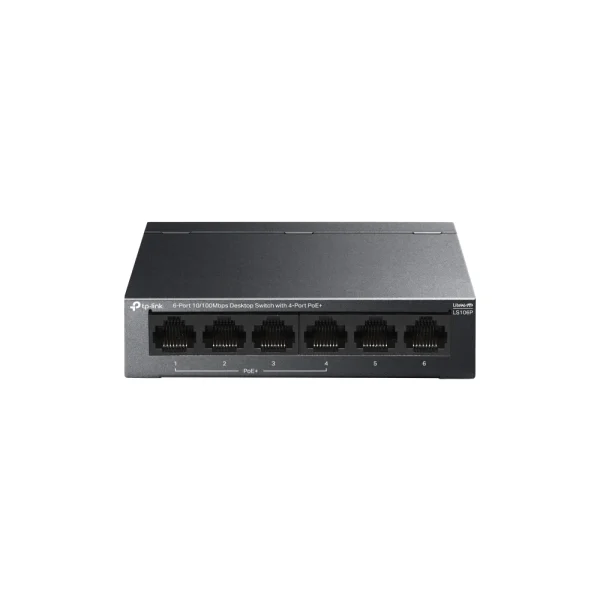
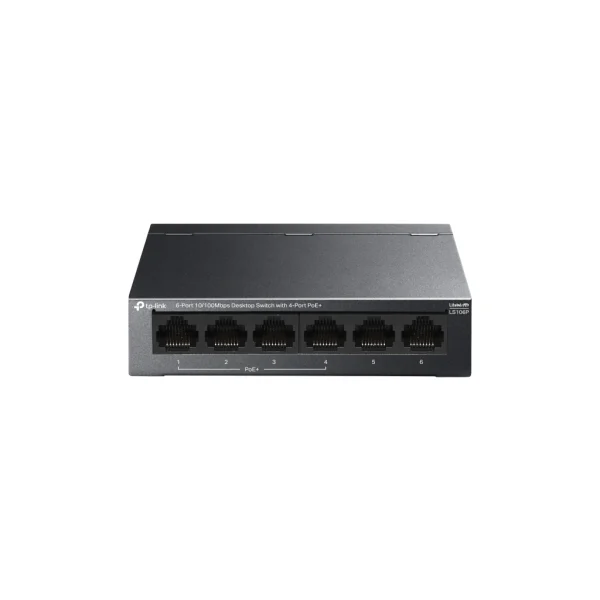
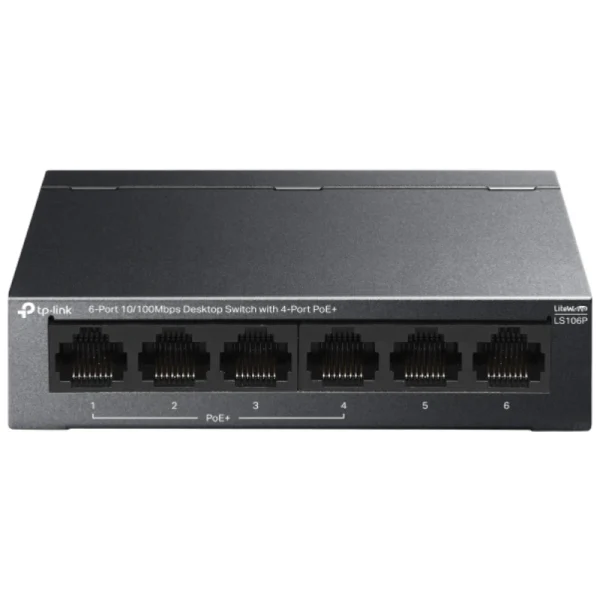
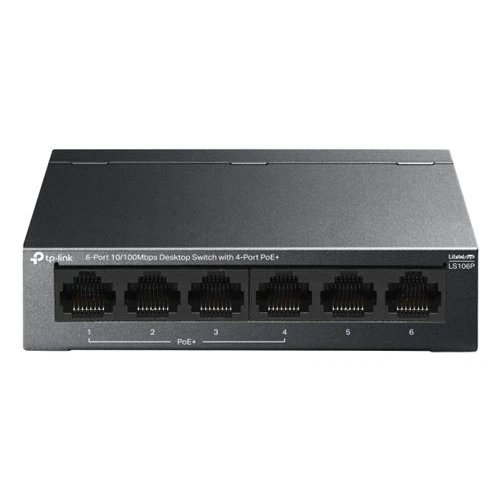
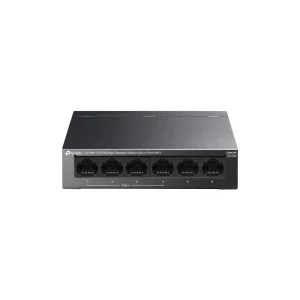
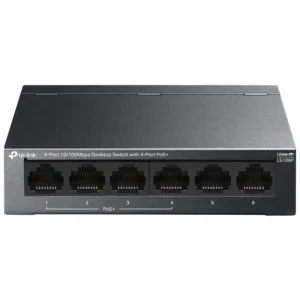
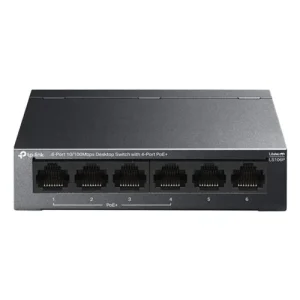
TP-Link LS106P 6-Port PoE+ Switch
₨5999.00
- 4 × 10/100 Mbps PoE+ ports (up to 30W each, 65W total budget)
- 2 extra non-PoE ports for router, PC or NVR
- Extend Mode reaches up to 250 m for distant cameras
- Fanless and silent, with PoE Auto Recovery
- Description
- Reviews (0)
Description
Overview
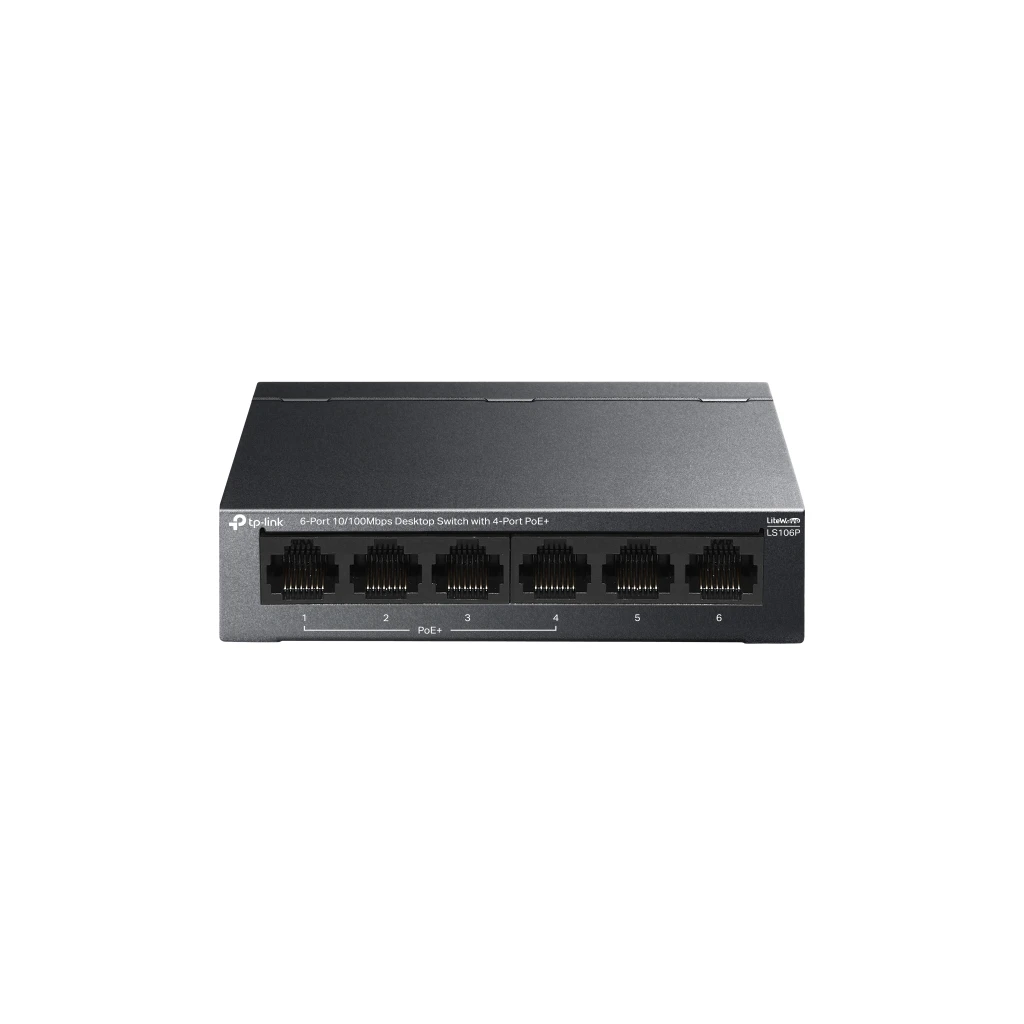
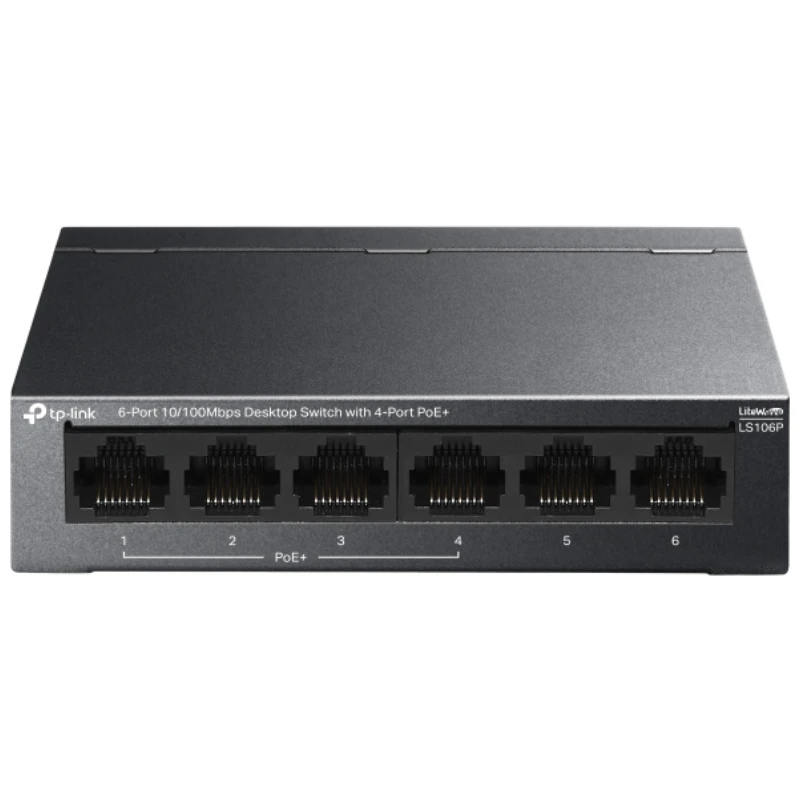
The TP-Link LS106P is a small PoE+ switch for small camera and Wi-Fi setups. It gives you six 10/100 Mbps ports: four PoE+ ports that supply power and data over a single cable, and two extra non-PoE ports for your router, PC or NVR. With a 65 W PoE budget, it runs up to four IP cameras or access points at once.
The LS106P belongs to TP-Link’s LiteWave LS1 series, the PoE branch of the same budget-friendly family as the LS1005 and LS1008. It is unmanaged and plug-and-play: connect the included 53.5 V power adapter, plug in your cameras or access points, and the switch supplies the power each device needs.
Ports 1 to 4 are the PoE+ ports, each able to supply up to 30 W. Ports 5 and 6 carry data only, and they are where the router or NVR plugs in. The case measures just 99.8 × 98 × 25 mm, so it fits on a desk, a shelf or a wall where a rackmount switch would be overkill.
Key Benefits
Four powered ports, no extra power supplies. Each PoE+ port delivers up to 30 W alongside the data, so an IP camera or Wi-Fi access point needs only its Ethernet cable. A TP-Link EAP225-Wall or TP-Link EAP235-Wall access point runs straight from a PoE+ port.
A 65 W budget for a real small system. Four typical IP cameras draw far less than 65 W between them, and a mix of two cameras and two access points fits comfortably too. Ports 1 and 2 are priority ports, so the most important devices keep their power first if the budget ever runs short.
Reach up to 250 metres. Extend Mode pushes PoE and data up to 250 m on ports 1 to 4 — two and a half times the normal 100 m limit. Ports drop to 10 Mbps in this mode, still enough for a camera stream.
Silent, and it looks after itself. The switch is fanless, so it makes no noise in a bedroom, shop counter or small office. PoE Auto Recovery restarts any device that stops responding, and Isolation Mode keeps the devices on ports 1 to 4 from talking to each other.
Features and Advantages
Each of the four PoE+ ports follows the IEEE 802.3af/at standards and can supply up to 30 W, with the 65 W total budget shared across the ports. The switch negotiates power with each device, so a small camera draws only what it needs, and overload protection steps in if a device draws too much.
Behind the ports, the LS106P switches at 1.2 Gbps with a 0.893 Mpps forwarding rate, a 2K MAC address table and a 768 Kb packet buffer, using store-and-forward transmission. A 2 KB jumbo frame keeps larger transfers efficient, and flow control (IEEE 802.3x) with back pressure stops packet loss when a device is busy.
Three features suit camera work. Extend Mode stretches reach to 250 m on ports 1 to 4. Isolation Mode stops devices on those ports from communicating with each other, and PoE Auto Recovery power-cycles any device that stops answering — often fixing a frozen camera without anyone climbing a ladder.
The hardware is practical for a small room: a compact 99.8 × 98 × 25 mm case for desk or wall mounting (holes 39 mm apart), a fanless design, and LEDs for power, link/activity and PoE status. The included 53.5 VDC / 1.31 A adapter supplies the full 66.53 W the switch can draw at maximum load. Double-check the model name on arrival — the LS106LP looks similar but is a different, larger switch with a 41 W budget, so confirm the box says LS106P.
Ideal Users
The LS106P suits anyone with a small camera or Wi-Fi setup. In a home, it powers two or three indoor cameras and a wall-plate access point from one small box in a cupboard. In a small shop, it runs the counter and stockroom cameras plus an access point for customers, with the billing PC on a non-PoE port.
Small offices use it for a meeting room or a single floor: a ceiling access point such as the TP-Link EAP225 AC1350 on a PoE+ port, a camera at the entrance, and the router on a non-PoE port.
This is not the switch for a bigger job. Four PoE ports and a 65 W budget will not cover an eight-camera system, and the 10/100 Mbps ports are not meant for Gigabit devices such as a NAS. For those jobs, step up to the LS1210P.
Technical Specifications
| Specification | Details |
|---|---|
| Model | TP-Link LS106P (LiteWave LS1 series) |
| Ports | 6 × 10/100 Mbps RJ45 (ports 1–4 PoE+, ports 5–6 non-PoE) |
| PoE Standard | IEEE 802.3af / 802.3at (PoE+) |
| PoE Per Port | Up to 30 W |
| Total PoE Budget | 65 W |
| Switching Capacity | 1.2 Gbps |
| Packet Forwarding Rate | 0.893 Mpps |
| MAC Address Table | 2K |
| Packet Buffer | 768 Kb |
| Jumbo Frame | 2 KB |
| Transmission | Store and Forward |
| Standards | IEEE 802.3, 802.3i, 802.3u, 802.3x, 802.3af, 802.3at |
| Features | Extend Mode (up to 250 m, ports drop to 10 Mbps), Isolation Mode, PoE Auto Recovery — all for ports 1–4; Priority ports 1–2 |
| Fan | Fanless (silent) |
| Power | External power adapter 53.5 VDC / 1.31 A (included) |
| Max Power Consumption | 66.53 W |
| Dimensions | 99.8 × 98 × 25 mm |
| Mounting | Desktop / wall-mount (mounting holes 39 mm apart) |
| LEDs | Power, Link/Act, PoE Status |
| Operating Temperature | 0–40 °C |
| Storage Temperature | −40–70 °C |
| Operating Humidity | 10–90% RH, non-condensing |
| Certifications | CE |
| MTBF | 6,855,262 hours at 25 °C |
| In the Box | Switch, power adapter, rubber feet, installation guide |
FAQs
How many PoE devices can the LS106P power?
Up to four — one per PoE+ port (ports 1 to 4), each up to 30 W, within the 65 W total budget.
What are ports 5 and 6 for?
They are non-PoE data ports for your router, PC or NVR — only ports 1 to 4 supply PoE.
What is Extend Mode?
Extend Mode lets ports 1 to 4 reach up to 250 m instead of 100 m. Port speed drops to 10 Mbps, still enough for a camera stream.
What are priority ports?
Ports 1 and 2 are priority ports. If demand ever exceeds the 65 W budget, these two keep their power first, so your most important camera or access point stays online.
Is the LS106P the same as the LS106LP?
No — they are different models with the same port count. The LS106P here has a 65 W budget and a 99.8 × 98 × 25 mm case; the LS106LP has a 41 W budget and a larger 158 × 101 × 25 mm case. Check the model name on the box.
What comes in the box?
The switch, a 53.5 VDC / 1.31 A power adapter, rubber feet and an installation guide.
Why Buy From NexGenShop.pk?
NexGenShop.pk stocks genuine TP-Link networking gear at fair prices across Pakistan, and the LS106P at Rs 5,999 is one of the cheapest ways to power a small camera or access-point setup properly. You get a sealed, genuine unit with local support and delivery across the country, and you can reach the team on Facebook or Instagram with any question. The same store carries the devices that pair with it — PoE-powered access points like the EAP225-Wall and EAP235-Wall, and larger PoE switches such as the LS1210P.
Final Conclusion
The TP-Link LS106P is the switch to buy when you have up to four cameras or access points and want them powered and connected with one cable each. A 65 W PoE+ budget, two spare ports for the router and NVR, Extend Mode up to 250 m and silent fanless operation cover the real needs of a small setup.



Reviews
There are no reviews yet.