

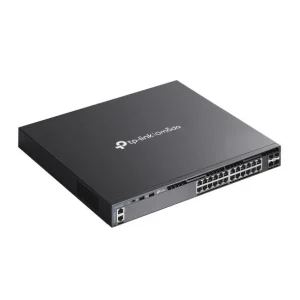
TP-Link SG6428X Managed Switch L3 24-Port
₨214999.00
- 24 Gigabit RJ45 ports plus 4x 10G SFP+ uplinks for high-speed aggregation
- Full Layer 3 routing with OSPF, static routing, VRRP and 10,240 hardware routes
- Physical stacking for up to 8 units with 80 Gbps stacking bandwidth
- Managed through Omada SDN, web GUI, CLI or SNMP with dual image and configuration
- Description
- Reviews (0)
Description
Overview
The TP-Link SG6428X is an Omada enterprise-grade Layer 3 managed switch for networks that have outgrown basic gigabit switching. It gives you 24 Gigabit Ethernet ports plus four 10G SFP+ slots, 128 Gbps of switching capacity and a 95.2 Mpps forwarding rate, so traffic moves at wire speed at full load.
This is an aggregation switch. It sits between your access switches and your core or router, gathers traffic from whole floors or buildings, and routes it with static routing, RIP, OSPF and VRRP instead of sending everything to a separate router. It is managed through Omada SDN, or on its own through the web interface or command line. Note: the SG6428X is a non-PoE switch — it does not power access points or cameras, which is why it costs less than its PoE sibling, the SG6428XHP.
Key Benefits
The first benefit is headroom. A 128 Gbps backplane with 64 Gbps of forwarding bandwidth means the switch never becomes the slow point in your network, even at full load across all 24 ports. The four 10G SFP+ uplinks give you a fast path to a core switch or server, and up to two slots accept 10G RJ45 SFP+ modules for copper uplinks.
The second benefit is routing where it matters. With 10,240 hardware routes, OSPFv2 and OSPFv3, RIP, ECMP and VRRP, the SG6428X routes between VLANs and subnets at hardware speed, so inter-VLAN traffic does not have to travel up to a router and back.
The third benefit is growth without replacement. Physical stacking links up to eight units in standalone mode, or four under an Omada controller, with up to 80 Gbps of stacking bandwidth, and the stack is managed as one switch. It also stacks with the SG6428XHP, SG6654X and SG6654XHP. Two fixed power modules, four fixed fans, dual image and configuration and a 614,086-hour MTBF keep it running, at just 27.6 W maximum draw.
Features and Advantages
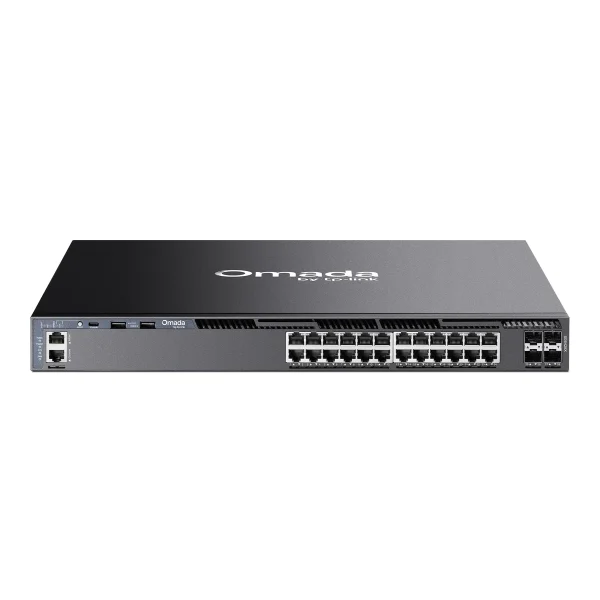
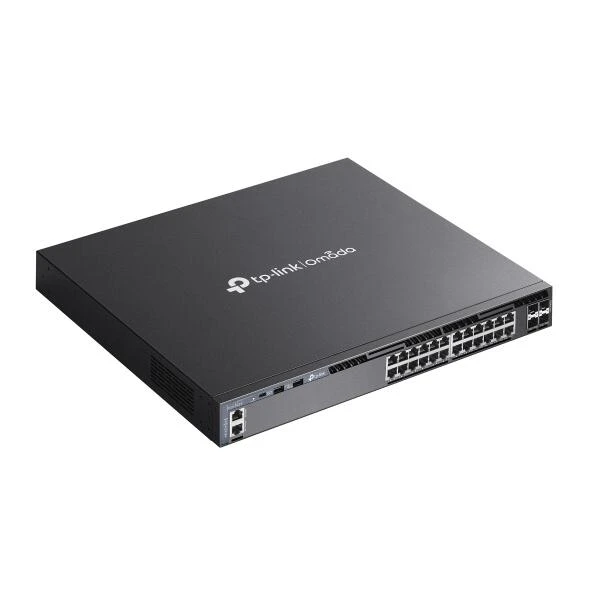
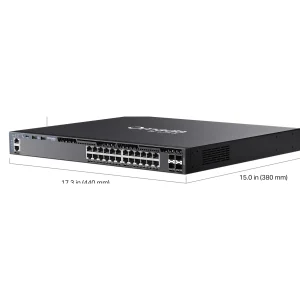
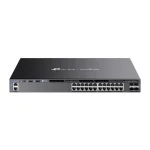
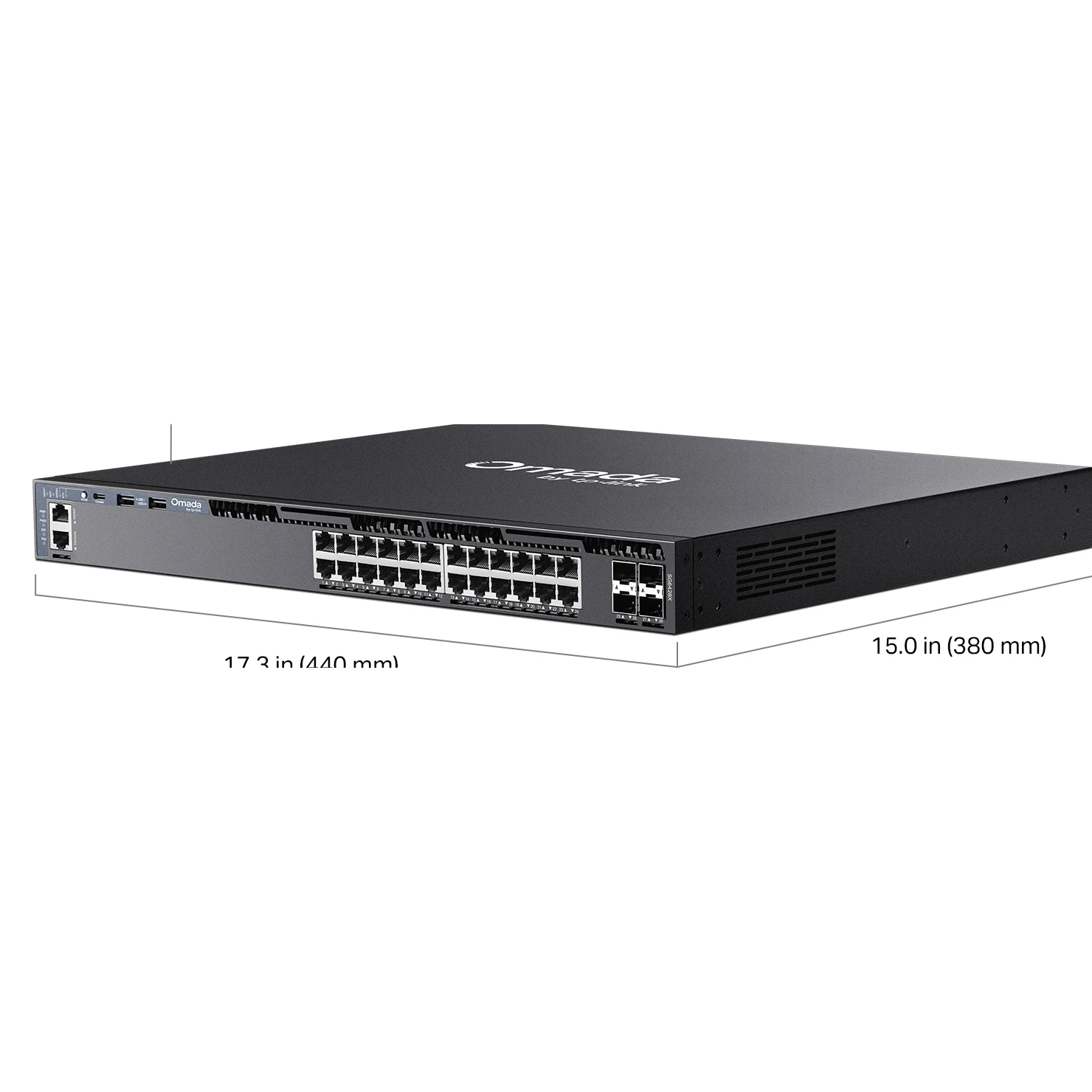
The front panel carries 24 10/100/1000 Mbps RJ45 ports, four 10G SFP+ slots, an RJ45 console port, a USB Type-C console port, a dedicated RJ45 management port and two USB 2.0 ports. The two console options make both old and new management cables work, and the dedicated management port keeps management traffic separate from data traffic.
Layer 2 is covered in full: 4K VLANs, QinQ, MAC VLAN, private VLAN, GVRP, link aggregation up to 64 groups, spanning tree in all three forms, ERPS ring protection, IGMP and MLD snooping, LLDP and L2PT. Layer 3 adds static routing, RIP v1/v2 and RIPng, OSPFv2/v3, ECMP with up to 256 routes and 32 next hops per destination, VRRP in versions 2 and 3, PIM-DM, PIM-SM and PIM-SSM, DHCP for IPv4 and IPv6, and 1,024 VRF instances.
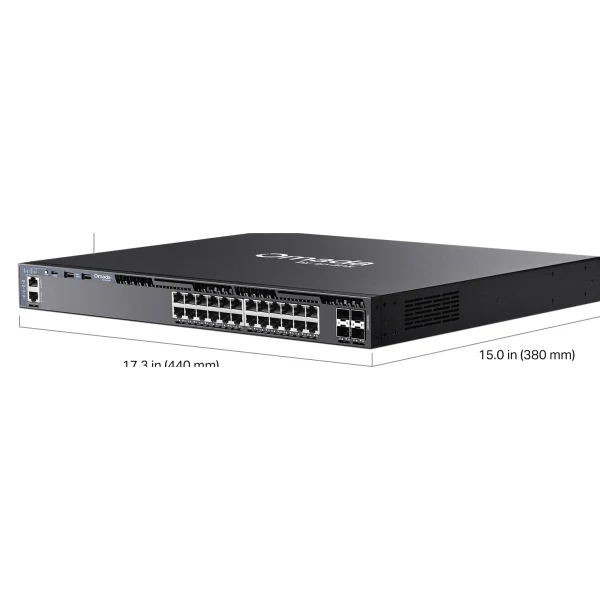
Security is handled at the switch: access control lists, port security, DoS defence, 802.1X authentication, dynamic ARP inspection and IP-MAC-port binding. Management is flexible — Omada SDN with the app, a hardware controller, the software controller or the cloud-based controller, with zero-touch provisioning, or standalone through the web GUI, the command line, SNMP or RMON. Dual image and dual configuration mean a failed firmware upgrade does not lock you out. Physically it is a 1U rackmount unit, 440 × 380 × 44 mm and 5.29 kg.
Ideal Users
This switch is made for medium and large networks: offices with several floors, campuses, schools, hotels, hospitals and ISPs that need an aggregation layer between their access switches and their core. If your access switches are filling up, inter-VLAN traffic is crawling through a router, or 10G uplinks are planned, the SG6428X is the switch you buy once and build around.
It is also a natural fit for an Omada site. Pair it with the TP-Link EAP723 BE5000 ceiling access point or the TP-Link EAP723 BE5000 Wi-Fi 7 ceiling access point, the TP-Link EAP225 AC1350 ceiling access point, and the TP-Link EAP225-Outdoor access point, and the whole site runs from one Omada controller. It is not the right switch for a small home network, or if every port needs to power a device — in that case, look at the SG6428XHP instead.
Technical Specifications
| Specification | Details |
| Model | TP-Link SG6428X (Omada, V1) |
| Ports | 24x 10/100/1000 Mbps RJ45 (non-PoE) |
| Uplink Slots | 4x 10G SFP+ (max two 10G RJ45 modules, one column interval) |
| Console / Management | RJ45 + USB-C console; RJ45 management port; 2x USB 2.0 |
| Switching Capacity | 128 Gbps; 64 Gbps forwarding |
| Packet Forwarding Rate | 95.2 Mpps |
| MAC Address Table | Max 32K; packet buffer 24 Mbit (3 MB) |
| Jumbo Frame | 9 KB |
| Hardware Routes | Max 10,240 |
| Stacking | Physical, up to 8 standalone / 4 controller; up to 80 Gbps; stacks with SG6428X, SG6654X, SG6428XHP, SG6654XHP |
| Layer 3 Features | Static, RIP, OSPF, ECMP (256 routes, 32 nexthops), VRRP (64), PIM-DM/SM/SSM, DHCP (v4+v6), VRF 1,024 |
| Layer 2 Features | 4K VLANs, QinQ, MAC VLAN 256, Private VLAN, GVRP, LAG 64/8, STP/RSTP/MSTP, ERPS (32 rings), IGMP/MLD, LLDP, L2PT |
| Security | ACL, Port Security, DoS Defend, 802.1X, Dynamic ARP Inspection, IP-MAC-Port Binding |
| Management | Omada SDN, web GUI, CLI, SNMP v1/v2c/v3, RMON, ZTP, Dual Image/Config |
| Power Supply | 100–240 V ~50/60 Hz; 2 internal fixed modules |
| Max Power Consumption | 27.6 W @220V; 28.4 W @110V; standby 13.0 W |
| Fans / Noise | 4 fixed fans, front-to-back; 15.6–39.7 dBA @1m |
| Dimensions / Mounting | 440 × 380 × 44 mm (1U), rackmount; 5.29 kg |
| Temperature / Humidity | −5 to 50 °C @300 m; storage −40 to 70 °C; 10–90% RH |
| Surge / ESD Protection | Service port ±6 kV; ESD air ±15 kV, contact ±8 kV |
| MTBF | 614,086 h @ 25 °C |
| Certifications | CE, FCC |
| Memory / Processor | 4,096 MB DDR4; 8,192 MB EMMC; ARM @1.5 GHz |
| In the Box | Switch, power cord, console cable, rackmount kit, rubber feet, locking strap, guide |
FAQs
Is the SG6428X a PoE switch?
No. None of its 24 Gigabit ports supply power. To power access points, cameras or phones from the switch, the SG6428XHP is the PoE version of this platform, with 24 PoE+ ports.
How many SG6428X switches can be stacked?
Up to eight units in standalone mode, or up to four under an Omada controller. Stacking runs over the SFP+ uplinks at up to 80 Gbps.
Does it need an Omada controller to work?
No. It works on its own through the web interface, the command line or SNMP. A controller adds centralised management, the Omada app and zero-touch provisioning, which is worth having on a site with several Omada devices.
What is the difference between the SG6428X and the SG6428XHP?
Same switching performance, same 24 Gigabit ports, same four 10G SFP+ slots, same Layer 3 features. The HP adds 24 PoE+ ports, hot-swappable power modules and fan trays, and a deeper 440 × 420 × 44 mm chassis.
Why Buy From NexGenShop.pk?
NexGenShop.pk lists the SG6428X at Rs 214,999 with the exact model and specifications shown above. The switch is a current Omada model, sold as a complete unit with its power cord, console cable, rackmount kit, rubber feet, locking strap and installation guide. Orders are delivered across Pakistan. Matching access points are available in the same place — the TP-Link EAP225-Wall access point, the TP-Link EAP235-Wall access point and the TP-Link EAP655-Wall WiFi 6 access point. Follow NexGenShop.pk on Facebook and Instagram for new stock and offers.
Final Conclusion
The TP-Link SG6428X is a serious aggregation switch for networks that need proper Layer 3 routing, 10G uplinks and room to grow, without paying for PoE they will not use. Twenty-four Gigabit ports, four 10G SFP+ slots, 128 Gbps of switching capacity, OSPF and VRRP, stacking for up to eight units and Omada management add up to a switch that can anchor a network for years. At Rs 214,999, it is a solid foundation for an office, campus or ISP network.



Reviews
There are no reviews yet.