

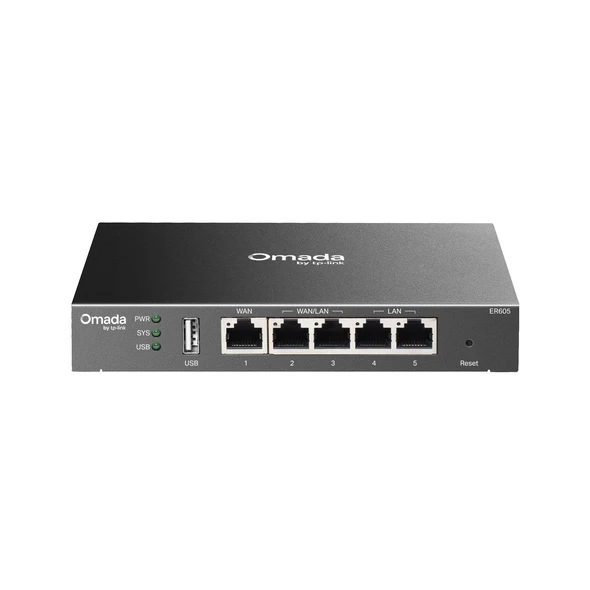
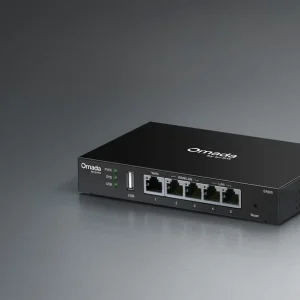
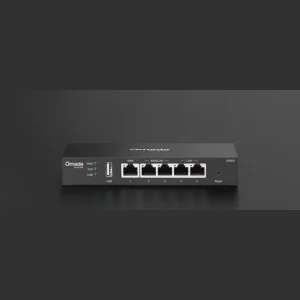
TP-Link ER605 Omada Gigabit VPN Router
₨18000.00
- 5 Gigabit Ethernet ports with up to 3 WAN connections and load balancing
- IPsec, WireGuard, OpenVPN, L2TP and PPTP VPN support for branch offices
- Omada SDN managed — app, hardware, software or cloud controller
- Fanless steel enclosure with USB port for 4G/3G modem backup
- Description
- Reviews (0)
Description
Overview
The TP-Link ER605 is a gigabit VPN router built for small offices and businesses with more than one branch. It sits at the edge of the network as the gateway, connecting the office to the internet and linking branch offices over VPN. It is part of TP-Link’s Omada SDN family, so it can be managed alongside Omada access points and switches.
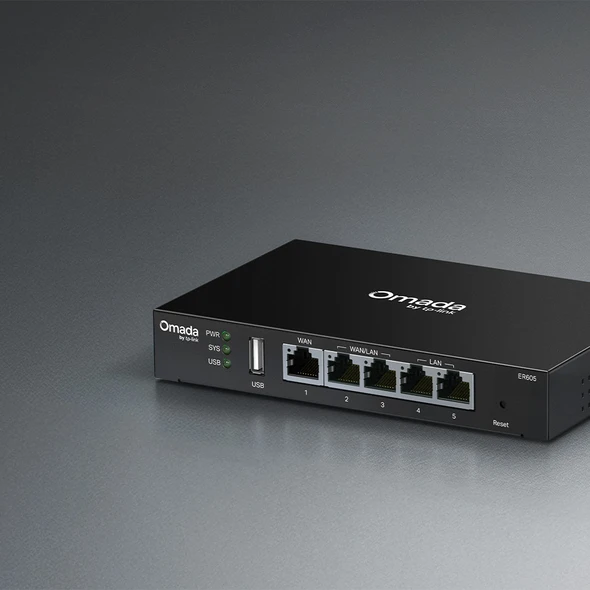
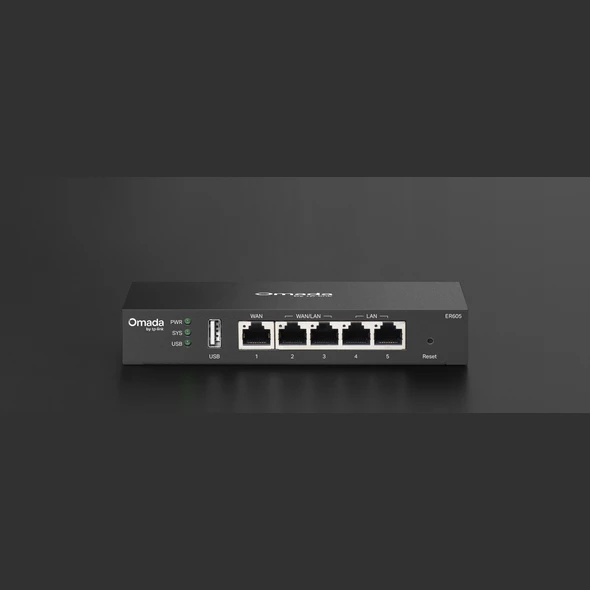
This is the v2 hardware, the current version. It has five Gigabit Ethernet ports: one dedicated Gigabit WAN port, two Gigabit WAN/LAN ports that can be set as either, and two Gigabit LAN ports. That gives it up to three WAN Ethernet connections at once, plus a USB 2.0 port for a 4G/3G modem as backup WAN.
Under the hood, the ER605 handles 150,000 concurrent sessions and 1,800 new sessions per second, with NAT throughput of 941.64 Mbps upload and 944.35 Mbps download on a static IP connection. On VPN it supports IPsec (20 tunnels), WireGuard (20), OpenVPN (16), L2TP (16) and PPTP (16), plus GRE and SD-WAN in controller mode. IPsec throughput is 250.94 Mbps and WireGuard runs at 82.62 Mbps, so encrypted links are fast enough for real work.
Key Benefits
The first benefit is uptime. Most small offices lose a working day when their single internet line goes down. The ER605 takes up to three WAN connections and balances the load between them, with link backup that moves traffic to a working line automatically when one fails.
The second benefit is that the VPN is built in, not bolted on. The ER605 handles IPsec, WireGuard, OpenVPN, L2TP and PPTP natively, with 20 IPsec and 20 WireGuard tunnels, so branch offices and remote staff are handled by the same device that routes the traffic.
The third benefit is centralised management. Adopted into an Omada controller — the app, a hardware controller like the OC200 or OC300, the software controller, or the cloud-based controller — the router, switches and access points are managed from one dashboard, with zero-touch provisioning for new sites. And the ER605 is quiet and cheap to run: a fanless steel box, 158 × 101 × 25 mm, drawing at most 7.94 W, with 4 kV surge protection.
Features and Advantages
Multi-WAN is the feature that defines this router. Up to three WAN Ethernet ports plus one USB WAN give four possible paths to the internet, with load balancing, link backup, and policy and static routing to send particular traffic down particular lines.
The firewall and security features are thorough for a router at this price: SPI firewall, DoS defence, IP-MAC binding, ARP inspection, IP, MAC and URL filtering, ACLs and a captive portal. IPTV is supported through IGMP v2/v3 proxy, and IPv6 is fully supported.
VPN is the other half of the story. IPsec runs at 250.94 Mbps and WireGuard at 82.62 Mbps — a large step up from the older v1, which managed only 41.5 Mbps on IPsec and had no WireGuard, no USB port and no SD-WAN. The router also works as a VPN client for up to 10 servers.
Management is flexible. Standalone, the web UI covers everything, with CLI, SNMP, syslog and port mirroring. Adopted into Omada, it gains cloud access and zero-touch provisioning. DPI throughput is 944 Mbps on TCP and 940 Mbps on UDP.
Ideal Users
The ER605 suits a small office that has outgrown a home router: a business with 10 to 50 people, a couple of internet lines, and a branch or two. The multi-WAN load balancing keeps the office online, the VPN joins the branches together, and Omada management keeps the whole thing under control from one place. It also suits a shop, a clinic, a school or a small hotel that cannot afford to lose internet.
It is a good fit for an Omada site. If the office already runs Omada access points, the ER605 is the gateway that completes the picture. What it does not suit is a home that only needs Wi-Fi and one internet line — it is a wired router with no wireless radios, so it always needs access points for Wi-Fi.
Technical Specifications
| Specification | Details |
|---|---|
| Model | TP-Link ER605 (v2) |
| Ports | 5× Gigabit Ethernet: 1× Gigabit WAN + 2× Gigabit WAN/LAN + 2× Gigabit LAN; 1× USB 2.0 (USB LTE dongle / 4G/3G modem as WAN backup) |
| WAN | Up to 3 WAN Ethernet ports + 1 USB WAN; load balancing, link backup, policy/static routing, RIP/OSPF |
| Sessions | 150,000 concurrent; 1,800 new sessions/sec |
| NAT throughput (Static IP) | Upload 941.64 Mbps / download 944.35 Mbps; bi-directional 1,775.32 Mbps |
| VPN | IPsec 20 tunnels (ESP-SHA256-AES256: 250.94 Mbps); WireGuard 20 tunnels (82.62 Mbps); OpenVPN 16 tunnels (15.90 Mbps); L2TP 16 tunnels (unencrypted 558.60 / encrypted 143.60 Mbps); PPTP 16 tunnels (unencrypted 616.33 / encrypted 49.83 Mbps); GRE; SD-WAN (controller mode only); VPN client — up to 10 servers |
| DPI throughput | TCP 944 Mbps / UDP 940 Mbps |
| Security | SPI firewall, DoS defense, IP-MAC binding, ARP inspection, IP/MAC/URL filtering, ACL, captive portal, ALG (FTP/H.323/SIP/IPSec/PPTP), IPTV IGMP v2/v3 Proxy |
| IPv6 | Full IPv6 support |
| Management | Omada App / OC200 / OC300 / Software Controller / Cloud-Based Controller; Cloud Access; Zero-Touch Provisioning (cloud controller); web UI; SNMP v1/v2c/v3; CLI (standalone only); syslog; port mirroring |
| Memory | 128 MB NAND flash; 256 MB DDR |
| Power | External 12 V / 1 A DC adapter; max power 7.94 W |
| Surge protection | 4 kV |
| Enclosure | Steel; fanless; desktop / wall-mount |
| Dimensions | 158 × 101 × 25 mm |
| LEDs / buttons | PWR, SYS, WAN, LAN, USB; reset button |
| Operating temperature | 0–40 °C; storage −40 to 70 °C; humidity 10–90% non-condensing |
| Certifications | CE, FCC |
| In the box | ER605, Power Adapter, RJ-45 Ethernet Cable, Quick Installation Guide |
FAQs
Is the ER605 a Wi-Fi router?
No. It is a wired VPN router with no wireless radios. It needs access points for Wi-Fi, such as the TP-Link EAP655-Wall indoors or the TP-Link EAP225-Outdoor outside.
What is the difference between the ER605 v1 and v2?
The v2, sold here, has five Gigabit ports including a USB 2.0 port for a 4G/3G modem, 150,000 concurrent sessions, IPsec at 250.94 Mbps, WireGuard, SD-WAN and GRE. The older v1 had no USB port, 25,000 sessions and IPsec at 41.5 Mbps.
Can it keep my office online if the main internet line fails?
Yes. With up to three WAN Ethernet ports plus a USB WAN, you can set a second line or a 4G dongle as backup. Link backup moves traffic to the working line automatically.
How many VPN tunnels does it support?
IPsec 20, WireGuard 20, OpenVPN 16, L2TP 16 and PPTP 16, plus GRE and SD-WAN in controller mode.
Does it need an Omada controller to work?
No. It works standalone through its web interface. An Omada controller adds centralised management, cloud access and zero-touch provisioning.
Why Buy From NexGenShop.pk?
NexGenShop.pk lists the ER605 v2 at Rs 18,000 with the full box contents as TP-Link ships them — the router, the power adapter, an RJ-45 Ethernet cable and the quick installation guide. The listing states the v2 specifications as published by TP-Link. The team can be reached on Facebook and Instagram if you need help choosing a gateway. The ER605 sold here is the v2. Pair it with the TP-Link EAP723 BE5000 for Wi-Fi 7 indoors and the TP-Link EAP225-Outdoor for outdoor coverage, and the whole site runs on one Omada setup.
Final Conclusion
The TP-Link ER605 v2 covers the three things a small business needs from a gateway: more than one way to reach the internet, a proper VPN to join its sites, and management that does not eat up the day. At Rs 18,000 it brings multi-WAN load balancing, 20 IPsec and 20 WireGuard tunnels, and Omada management into a fanless steel box that draws under 8 W. Order it from NexGenShop.pk.






Reviews
There are no reviews yet.