

TP-Link SG6428XHP PoE Switch L3 24-Port

₨269000.00
- 24 Gigabit PoE+ ports with 402W power budget as shipped, up to 720W with a second PSU module
- 4x 10G SFP+ uplinks, 128 Gbps switching and full Layer 3 routing
- Hot-swappable power modules and fan trays with N+1 redundancy
- Physical stacking for up to 8 units, managed through Omada SDN
- Description
- Reviews (0)
Description
Overview
The TP-Link SG6428XHP is the PoE version of TP-Link’s Omada enterprise Layer 3 stackable switch, and it does two jobs at once: it routes and aggregates traffic like a proper convergence switch, and it powers the devices on your network. All 24 Gigabit ports are PoE+ ports, so one switch can run your Wi-Fi access points, IP cameras and VoIP phones over the same cables that carry their data.
Switching matches its non-PoE sibling, the SG6428X: 128 Gbps capacity, 95.2 Mpps forwarding, four 10G SFP+ uplinks and full Layer 3 routing. As shipped it comes with one PSM500-AC module and a 402 W PoE budget, covering a full rack of access points and cameras. A second PSM500-AC or a PSM900-AC lifts the budget to 720 W, but only with the extra module, sold separately — plan on the 402 W the box delivers.
Key Benefits
The first benefit is that power and data come from one box. Twenty-four PoE+ ports at up to 30 W each run a whole floor of access points and cameras, with ports to spare. Perpetual PoE keeps powered devices running during a switch reboot, and Fast PoE powers them back up quickly after a restart, so a firmware upgrade does not leave your wireless network dark.
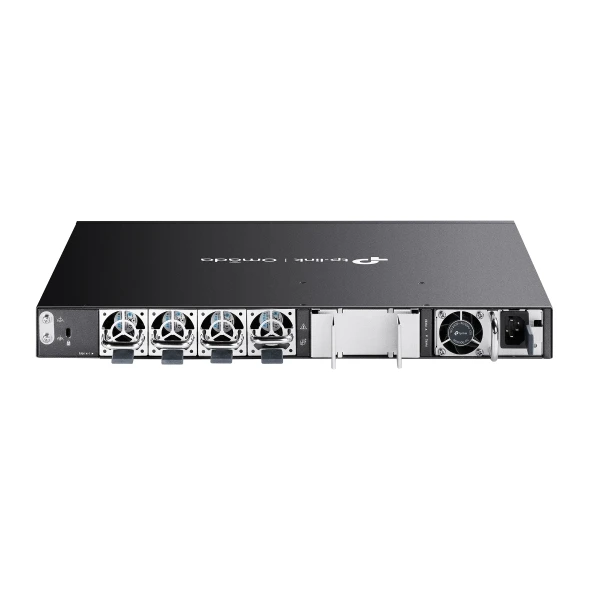
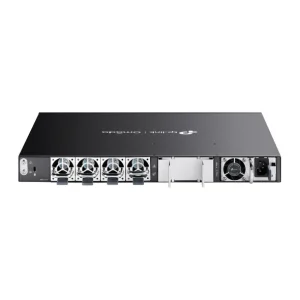
The second benefit is uptime. The power modules and the fan trays are hot-swappable, with N+1 redundancy, so a failed module can be pulled and replaced while the switch keeps running. Dual image and dual configuration add the same safety on the software side, and the 753,531-hour MTBF rating backs it up.
The third benefit is the same routing and stacking strength as the non-PoE model. OSPF, static routing, VRRP and 10,240 hardware routes, and stacking for up to eight units standalone or four under an Omada controller. It also stacks with the SG6428X, SG6654X and SG6654XHP. Under Omada SDN it joins the same controller as your access points and gateways, or works standalone via web, CLI or SNMP.
Features and Advantages
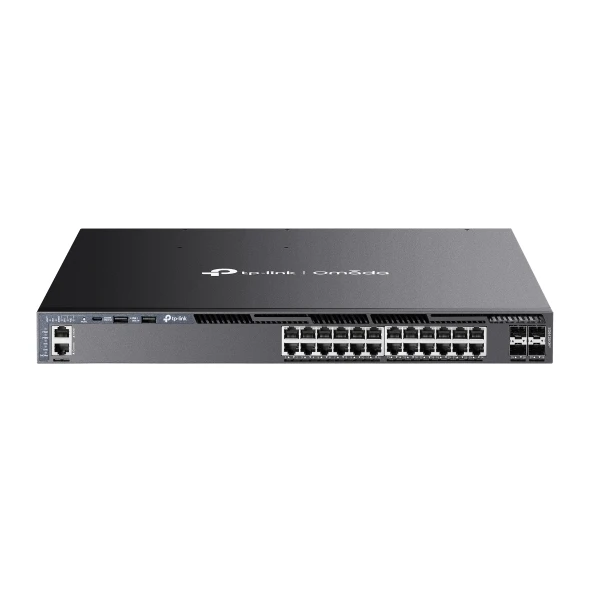
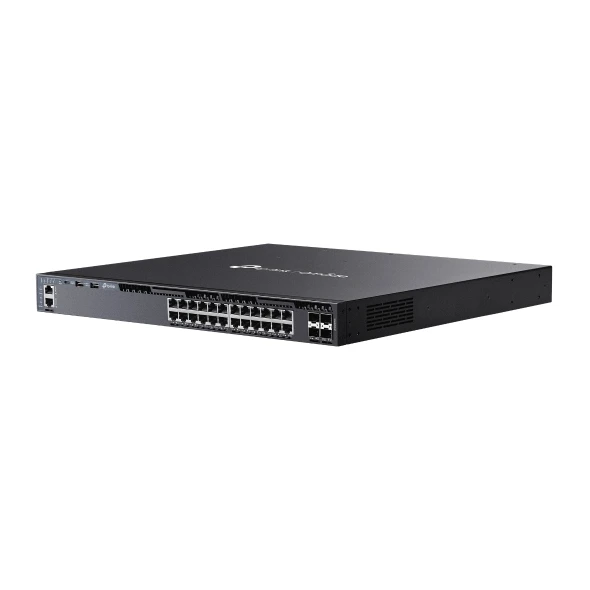
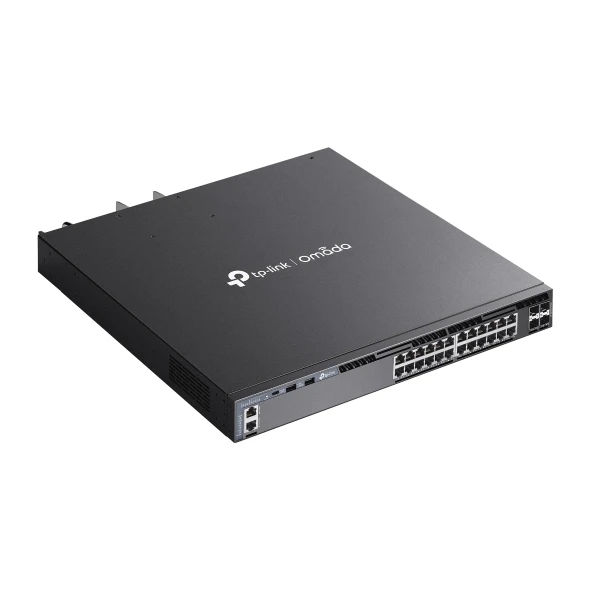
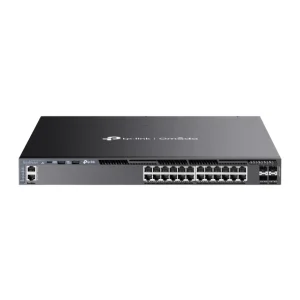
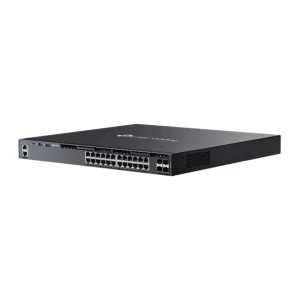
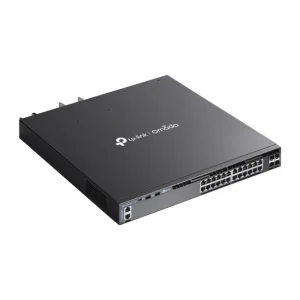
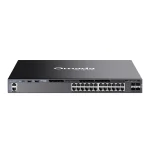
The front panel carries 24 10/100/1000 Mbps PoE+ RJ45 ports, four 10G SFP+ slots, an RJ45 console port, a USB Type-C console port, a dedicated RJ45 management port and two USB 2.0 ports. The PoE button and LEDs mark it out from the near-identical non-PoE SG6428X.
PoE follows the 802.3af and 802.3at standards, at up to 30 W per port — not 802.3bt, so devices needing more than 30 W need a different power source. The budget is 402 W with the single PSM500-AC module in the box, and 720 W with a second PSM500-AC or a PSM900-AC module. The extra module is sold separately, so decide before ordering whether 402 W covers your devices.
Layer 2 is fully covered: 4K VLANs, QinQ, MAC VLAN, private VLAN, GVRP, link aggregation, STP/RSTP/MSTP, ERPS, IGMP/MLD, LLDP and L2PT. Layer 3 adds static routing, RIP, OSPF, ECMP (128 routes), VRRP (64), PIM-DM/SM, DHCP and 1,024 VRF instances. Security runs at the switch: ACLs, port security, DoS defence, 802.1X, ARP inspection and IP-MAC-port binding. The 1U chassis is 440 × 420 × 44 mm and 7.64 kg, rated to 45 °C, with CE, FCC and RoHS certification.
Ideal Users
This switch is made for networks with many powered devices: enterprises, campuses, hotels, schools and ISPs running Wi-Fi access points, IP cameras and VoIP phones from one convergence switch. Wiring a hotel, school or office floor? One SG6428XHP powers the edge and routes at Layer 3.
It pairs naturally with Omada access points: the TP-Link EAP225-Wall and TP-Link EAP235-Wall draw power straight from these PoE+ ports, as does the TP-Link EAP655-Wall WiFi 6 for newer rooms, while the TP-Link EAP723 BE5000 and TP-Link EAP723 BE5000 Wi-Fi 7 cover large ceilings from the same switch. No PoE needed? The SG6428X gives the same performance for Rs 54,000 less.
Technical Specifications
| Specification | Details |
| Model | TP-Link SG6428XHP (Omada, V1) |
| Ports | 24x 10/100/1000 Mbps PoE+ RJ45 |
| Uplink Slots | 4x 10G SFP+ (max two 10G RJ45, slots 49 & 53) |
| Console / Management | RJ45 + USB-C console; RJ45 management port; 2x USB 2.0 |
| PoE Standard | IEEE 802.3af/at; Perpetual PoE + Fast PoE |
| PoE Ports | 24, up to 30 W per port |
| PoE Power Budget | 402 W (as shipped); 720 W (2x PSM500-AC or PSM900-AC) |
| Switching Capacity | 128 Gbps; 64 Gbps forwarding |
| Packet Forwarding Rate | 95.2 Mpps |
| MAC Address Table | 32K; packet buffer 24 Mbit (3 MB) |
| Jumbo Frame | 9 KB |
| Hardware Routes | 10,240 |
| Stacking | Physical, up to 8 standalone / 4 controller; up to 80 Gbps; stacks with SG6428X, SG6654X, SG6428XHP, SG6654XHP |
| Layer 3 Features | Static, RIP, OSPF, ECMP (128 routes), VRRP (64), PIM-DM/SM, DHCP (v4+v6), VRF 1,024 |
| Layer 2 Features | 4K VLANs, QinQ, MAC VLAN 200, Private VLAN, GVRP, LAG 64/8, STP/RSTP/MSTP, ERPS (16 rings), IGMP/MLD, LLDP, L2PT |
| Security | ACL, Port Security, DoS Defend, 802.1X, Dynamic ARP Inspection, IP-MAC-Port Binding |
| Management | Omada SDN, web GUI, CLI, SNMP v1/v2c/v3, RMON, ZTP, Dual Image/Config |
| Power Supply | 100–240 V; 2 hot-swappable modules, N+1; ships 1x PSM500-AC |
| Max Power Consumption | 42.9 W (no PD); 916.6 W (720 W PD); standby 32.0 W |
| Fans / Noise | 4 hot-swappable trays, N+1; 35.2–57.4 dBA |
| Dimensions / Mounting | 440 × 420 × 44 mm (1U), rackmount; 7.64 kg |
| Temperature / Humidity | −5 to 45 °C @2,000 m; storage −40 to 70 °C; 10–90% RH |
| Surge / ESD Protection | Service and power ports ±6 kV; ESD air ±15 kV, contact ±8 kV |
| MTBF | 753,531 h @ 25 °C |
| Certifications | CE, FCC, RoHS |
| Memory / Processor | 4,096 MB DDR4; 8,192 MB EMMC; ARM @1.5 GHz |
| In the Box | Switch, power cord, RJ45 console cable, quick installation guide, rackmount kit, rubber feet |
FAQs
What is the PoE budget as shipped?
402 W, with the single PSM500-AC module in the box. The often-quoted 720 W needs a second PSM500-AC or a PSM900-AC module, sold separately — check device power against 402 W unless ordering the extra module.
Can power modules and fans be replaced while the switch runs?
Yes. Both are hot-swappable, with N+1 redundancy, so a failed module can be swapped without taking the switch down.
How many SG6428XHP switches can be stacked?
Up to eight in standalone mode, or four under an Omada controller, with up to 80 Gbps of stacking bandwidth. The stack can also include the SG6428X, SG6654X and SG6654XHP.
What is the difference from the SG6428X?
Same switching performance, same 24 Gigabit ports, same four 10G SFP+ slots and the same Layer 3 features. The HP adds 24 PoE+ ports, hot-swappable power modules and fan trays, and a deeper 440 × 420 × 44 mm chassis — for Rs 54,000 more.
Why Buy From NexGenShop.pk?
NexGenShop.pk lists the SG6428XHP at Rs 269,000 with the exact model and specifications shown above, including the real PoE budget — 402 W as shipped. It is a current Omada model, sold complete with its PSM500-AC module, power cord, console cable, guide and rackmount kit. Orders are delivered across Pakistan. Matching wall-plate access points are in the same place — the TP-Link EAP225-Wall access point, the TP-Link EAP235-Wall access point and the TP-Link EAP655-Wall WiFi 6 access point. Follow NexGenShop.pk on Facebook and Instagram for new stock and offers.
Final Conclusion
The TP-Link SG6428XHP is the switch to buy when one box has to do two jobs: route and aggregate traffic at Layer 3, and power a whole floor of access points, cameras and phones while it does it. Twenty-four PoE+ ports with a 402 W budget as shipped, four 10G SFP+ uplinks, 128 Gbps of switching capacity and hot-swappable power and fans make it a convergence switch for a busy building. At Rs 269,000 from NexGenShop.pk, it fits any enterprise, campus, hotel or school on Omada.




Reviews
There are no reviews yet.